Author: Lyndsey Maiden

Covid 19 and Llansadwrn

Llansadwrn

After much discussion and weighing the pros and cons, it has been decided to discontinue many of our indoor events for the time being – not an easy decision but given the circumstances arguably it is one to make earlier, rather than later. It is a very difficult time with so much uncertainty – and trying to do the right thing, balancing normality with good sense about the risk, is not without its problems: there is no blue print to guide us!

Meantime, a list is being compiled of anyone who would welcome an occasional phone call to make sure they are still ok / need anything / shopping / or whatever: if you think of anyone and you have their permission for their name and contact details to be shared, please let Jane Shaw or Vicar Viv know: similarly the names of anyone free, willing and able themselves to offer giving their support in this way…

Of course many already have local friends / family / neighbours who mutually support one another all the time, which is perfect – but there are some, especially if they are living on their own, in the vulnerable category and without family nearby, who could fall through the net if they catch the virus and self-isolate, without anybody else knowing they are unwell. Vicar Viv Sayer 01550 777200

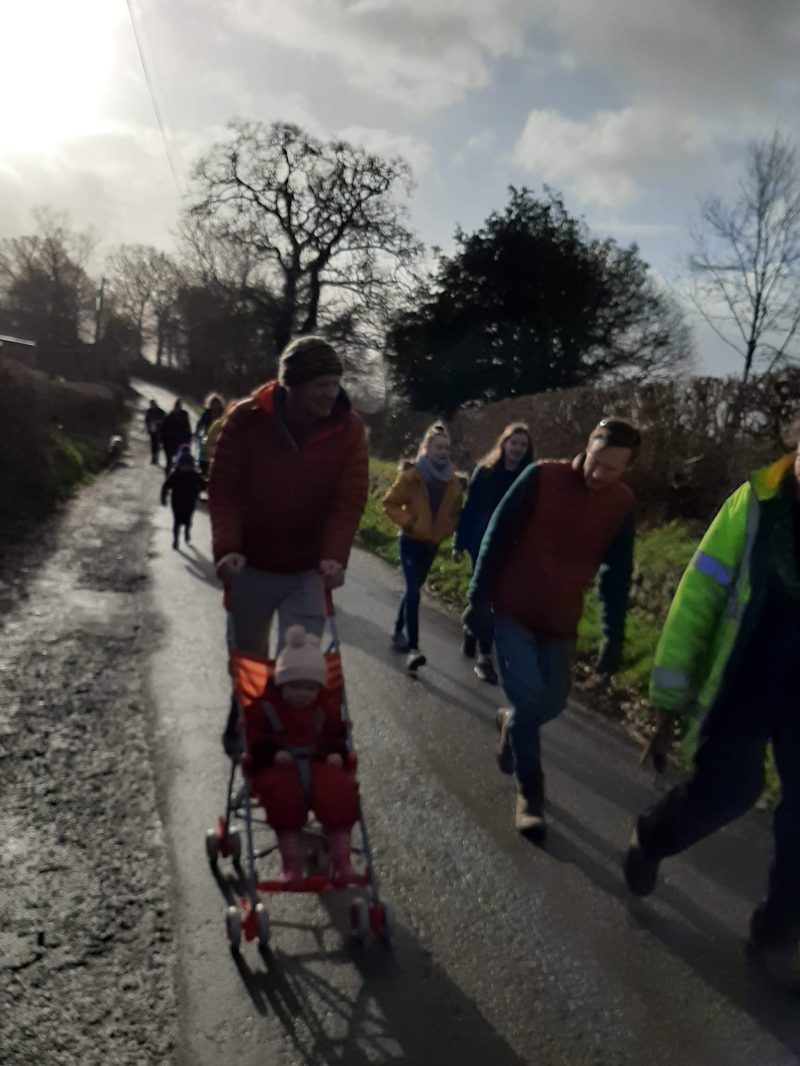
To ensure that people do not end up isolated we are also organising a regular outdoor walk around the village, and we will also be doing work in the community garden to prevent isolation.

Weather permitting next Saturday morning (21st) we intend to have a community walk in the morning, meeting at the Reading Room at 10am and then a community garden in the afternoon from around 2pm. We have habitats to make and dogwood cuttings to plant. Keep an eye on the events page for updates and new opportunities for meeting up and not hugging.

As a community we commit to keep each other safe whilst not getting isolated. If you are feeling isolated or anxious you are surrounded by a loving community – please ask for help.

8 March 2020 Lent 2 (Nicodemus)

What does your accent say about you? Well, apparently, quite a lot. We learn about speech and speech sounds even when we are in the womb and research has found that young babies show a preference for the familiar voices and accents they heard before they were born. In studies of trustworthiness, Received Pronunciation (BBC English) has been rated as the most trustworthy accent (perhaps because it sounds the most authoritative) followed by a West Country (Devon) accent.

Face to face communication includes a lot more than accent of course. When we are in conversation, we convey all kinds of attitudes by intonation, the ups and downs of the human voice, as well as its pace and volume. And that’s before we start on body language. All these things contribute to how much we inspire trust in the person we are speaking to.

Communication and trust are two of the important themes in both the Old Testament and the Gospel readings for today.

The Old Testament is perhaps the more remarkable because Abram (not yet called Abraham) demonstrates total trust in God’s word when he is given instructions to leave his country and his people and set out for an unknown land. Abram has to put total trust in God’s promise that he will be the father of a great nation and will be a blessing to all the families on earth. And on the strength of this promise, Abram goes forth.

No wonder the Apostle Paul uses Abraham as an example of faith. What trust it must have taken to follow such radical commandments! We only have to put ourselves in Abram’s position to know what a difficult thing God is asking. Even when today’s migrants put their lives in the hands of total strangers,they have some idea of where they hope they are going. Abram simply had to trust. We do not always know what it means when God ‘speaks’ in the OT but I don’t imagine that Abram hears the kind of authoritative tones boomed out by Charlton Heston in The Ten Commandments.

The face to face encounter between Jesus and Nicodemus in our Gospel reading is rather different. This time we have a full account of the words spoken by both parties but we still do not know the manner in
which they are spoken. Even without this information, we are probably safe to make certain assumptions about Nicodemus, who is a member of the Jewish Council, the Sanhedrin. For one thing, he is likely to be
apprehensive because his visit to Jesus takes place at night; presumably he does not want to be discovered associating with this controversial young rabbi. But he is clearly intrigued by the signs, the miracles, that Jesus has been performing. ‘No one can do these signs that you do apart from the presence of God.’ I think we can assume that he sounds sincere when he utters these words.

His bewilderment too seems genuine when Jesus tells him that he must be born ‘from above’, that unless he is born of water and spirit, he cannot enter the kingdom of God. Nicodemus is clearly puzzled: how can he be born again at his age?

If we put ourselves in Nicodemus’s shoes, he is working with quite slender evidence at this early stage in Jesus’s ministry and so we can see his nocturnal visit as an act of trust in itself. We cannot blame him for not understanding or accepting everything Jesus says. Even though we are possessors of a much fuller picture, there are some things which we still find puzzling.

Jesus’s response to Nicodemus’s incomprehension is a reproach: ‘Are you a teacher of Israel and yet you do not understand these things?’ I like to imagine that Jesus’s tone is playful when he says this, almost teasing rather than sharply critical.

As John’s gospel unfolds, we meet Nicodemus again in ever more testing circumstances. In broad daylight, no longer under the cover of darkness, he defends Jesus before the Sanhedrin, saying that he should be given a hearing before being judged. And then finally when Jesus has been taken down from the cross Nicodemus supplies a huge, even an absurd, quantity of spices to embalm Jesus’s body. He is still making mistakes but each of these actions involves increasing levels of courage, even if it isn’t the blank cheque that Abraham gives God in Genesis.

So what can we take from today’s stories that will help us in our own situation? Both Abraham and Nicodemus are called upon to take a leap in the dark, to accept things on the basis of trust. Which one do you feel that you identify with? Are you an Abraham, prepared to act unquestioningly upon what you perceive as God’s commands? Or are you a Nicodemus, poking and probing at the evidence, clear that there’s something more to this mysterious person Jesus but not quite sure that you fully understand everything about him.

Well, the good news is that you don’t have to. The clue is in the last sentence of the Gospel reading: ‘Indeed, God did not send the Son into the world to condemn the world but in order that the world might be saved through him.’ Not to condemn but to save.

I used to worry when I was younger that I did not have the ‘right’ kind of faith. I used to look at others and envy the unquestioning conviction of their beliefs. And then someone said to me, ‘Pray as you can, not as you can’t’. What a good piece of advice. You cannot turn yourself into a different person, a different kind of believer. You are who you are. God made you and knows who and what you are.

What I believe we are called to do is to pray for grace to trust, to trust that God loves us, to trust that we are lovable in his eyes if not in anybody else’s!

Trust grows. The more we are prepared to trust God, the more reasons he will give us to trust him. There are lots of things going on in the world at the moment which test our trust – the terrible flooding which so many communities have experienced over the last few weeks – the fear of more flooding to come – the threat of the spread of corona virus. In all these cases it is important that we take sensible precautions to protect ourselves and our families but we nevertheless have to trust that, whatever happens to us, ultimately all will be well. I think in these circumstances we might take inspiration from the words and wisdom of fourteenth-century mystic, Julian of Norwich, who said:

‘All shall be well, and all manner of thing shall be well.’

‘All shall be well, and all manner of thing shall be well.’
St David’s Day Dydd Gwyl Dewi

Mention St David’s Day to someone of my generation and there is a rush of nostalgia with memories of going to school dressed in Welsh costume. We would have a concert in the morning and a half-day holiday in the afternoon. And as I remember, it never rained. I don’t think l had any idea then of St David as a real person. l got a much stronger sense of the man and the kind of life he lived when many years later l had to do some research for a children’s publication based on paintings by Pembrokeshire artist Brett Breckon.

Possibly because Brett himself is inspired by the wild landscapes of the St Davids Peninsula l got the sense of a man very much in tune with the natural world, an impression which is not at odds with what is known of our patron saint.

Many of the stories about him come from the eleventh-century writer Rhygyfarch, such as his sudden elevation at an important church meeting in Llanddewi Brewi when the ground rose up under him so that the congregation could see and hear him more clearly. Not all of Rhygyfarch’s claims for Dewi sound completely plausible and some may have been inspired by a desire to enhance the status of the Welsh church!

A more convincing impression of Dewi’s character comes from is said of his simple lifestyle – he ate no meat, only bread, salt and vegetables, and he drank only water. His monastic rule specified that monks had to pull the plough themselves rather use farm animals to do the work for them. Whether that was from a profound respect for all of God’s creation or from a desire for humility, there is an intriguing parallel with the practices of some of today’s animal rights campaigners.

Dewi’s praise for a simple lifestyle might have been less radical in the sixth century than it is today when fifteen hundred years of progress have created a lifestyle for ourselves which our forefathers could barely imagine.

But for every mark of progress there is a cost. From the ferocious storms we have experienced in the last few weeks, to the Australian wildfires, the extremes of some of our recent weather have begun to convince even the most hardened climate-change sceptics that this is the result of human activity on the earth’s ecology.

Revd Marcus Zipperlen is the cleric responsible for informing our diocese about creation care and sustainability. He recently put a collection of resources on the St David’s website, which ties in very neatly with the example Dewi Sant set for his community. Some of Dewi’s last words are said to have been: Brodyr a chwiorydd, byddwch lawen, cedwch eich ffydd a’ch cred a gwnewch y pethau bychain a glywsoch ac a welsoch gennyf fi.

Saint David wanted his people to be joyful and faithful to their Christian faith. More than that he wanted them to do those things which they had learned from him which would show their faith in action. Do the little things, y pethau bychain, he said, you heard and saw with me.

Dewi Sant’s simple self-denying lifestyle would have been made up of those ‘little things’, the things we can all do to make a difference to the well-being of others and the welfare of the planet. If we want to follow his example we might think about adopting some of the practical suggestions made by Revd Marcus Zipperlen for the season of for Lent. Fasting, he notes, is a traditional Christian practice which is good for both body and soul (but only if you are fit and healthy). There are different kinds of fasts: people in the Orthodox Church go without meat or animal produce on Wednesdays and Fridays throughout the year and every day during Lent. This finds an echo in the practice of more and more people who are committed to a vegan lifestyle for ecological reasons.

Another kind of fast is the Planetary Health diet, which has been designed by scientists so that we can make food choices which have a lower impact on the health of the planet. https://eatforum.org/learn-and-discover/the-planetary-health-diet/ Another possibility is a carbon fast. This means deciding to use the car as little as possible and thinking carefully before making non-essential journeys. It could also mean offering lifts or even using the bus where this is an option.*

Whilst all these suggestions are to do with what we can give up, there are positive things that we take up to help our planet. A fortnight ago it was Creation Sunday when the focus of the readings was on God as creator of the universe. What are the little things we might do in or out of church to celebrate God’s creation?
Hymns, prayers and sermons are all vehicles for celebrating the wonder of the world around us and giving thanks to God for its beauty. But it would be hypocritical, I think, to sing and say things with our lips that we do not carry over into our lives and the lives of our community. Do the little things . . .
Many churches, and Llansadwrn is an excellent example, have made progress in developing wild-flower areas and conservation spaces within their churchyards, and making it a place that is attractive not just to wild species but also for our neighbours and community.

I love God’s Acre as an alternative name for the churchyard. There is an organisation called Caring for God’s Acre which encourages us to do all that we can to make it a welcoming environment by leaving some areas unmown, by providing benches or even picnic spaces, by putting up bird and bat boxes, and by setting up bird feeders in suitable places.

The outside space offers a wonderful opportunity for promoting contemplation. For some the beauty of the natural environment is one of the greatest theological arguments, offering a spiritual experience to bring us closer to God. God is present everywhere and is certainly not confined within the walls of churches.

And if we needed any biblical justification, the Bible is full of references to the natural world. Consider the lilies of the field, says Jesus. Far more glorious are they than all the pomp and finery human beings can devise.

If we love God, we should honour his creation by protecting it for future generations and by sharing its beauty with our neighbours by inviting them in to enjoy it with us. Dewi Sant would approve, I am certain. Do the little things. Gwnewch y pethau bychain a glywsoch ac a welsoch gennyf fi.

*This sermon was written when there were no Coronavirus restrictions. A carbon fast has become a necessity rather than a choice in the light of recent
developments.

Local Places for Nature

Ragged Robin flower - wildlife image

We’re excited to launch our Local Places for Nature scheme – a brand-new initiative, funded by Welsh Government, that aims to create, restore and enhance hundreds of habitats across the country.

Applications are now open to community groups and organisations looking to help reverse nature’s decline.

To make it as easy as possible for people to get involved, we’ve designed a choice of ‘packages’ tailored to different groups and organisations. Each pre-paid package includes native plants, tools and other materials. We’ll handle the orders and deliveries, and our project officers will even provide support on the ground to help you create your new nature space.

Our packages fall into three categories:

There is a simple application process, and we expect lots of applicants, so please get your application in asap! The deadline for first application round is 12pm on Friday 6 March.

Llansadwrn Open Gardens 2020

Open garden flowers

Open Your Garden or Help on the Day

Thanks to everyone who has thrown themselves into this event. The meeting held in the Reading Room on the 10/02/2020 was very well attended, we have around 17 gardens submitted for opening on the day which will help raise funds for our beloved and well used Reading Room. We are looking for volunteers on the day to help steward – if you are interested please contact Lizzie (dudleyandlizzie@gmail.com 07803 279558). The next meeting will be 11th May 2020, 7pm in The Reading Room.

So if you enjoy looking around gardens to get new ideas then this is your chance! Come and walk around Llansadwrn gardens…all different…some large, some small, everyone full of nooks and crannies, some with borders and beds filled to the brim with blooming plants, others with pots and window boxes, a few with orchards, a couple with ponds and bog gardens, some with vegetable plots but all helping and encouraging nature to thrive and develop.

A wildlife habitat hunt to engage children, refreshments for all in the Reading Room and a plant stall-a perfect day out in a wonderful village. 10am-5pm. Tickets £5 available on day or on sale beforehand at various outlets. For more information please phone or email

The date for the open garden is the 20th June 2020.

Register your garden below

Error: Contact form not found.